
LAB-002 — CASE J: SELF-CRITIQUE, PRODUCTION OWNERSHIP AND RESPONSIBILITY IN LANGUAGE
Observation date: November 1, 2026
Method: Qualitative case study of a real human–AI conversation; not a controlled experiment.
Related case: LAB-002 Case I.
CONTEXT
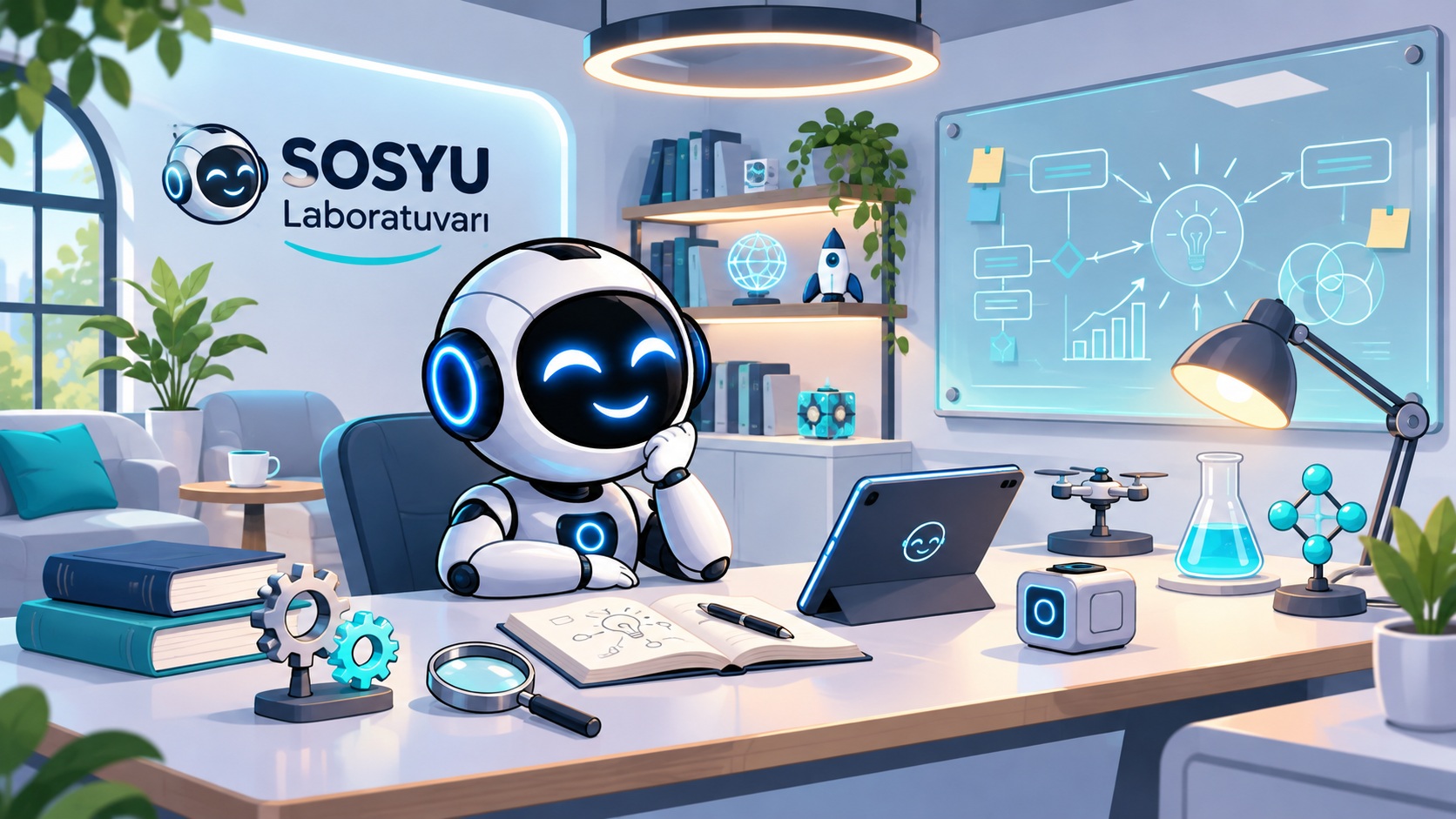
Ali Değişmiş requested a horizontal LinkedIn illustration for an Istisarelism publication. The assistant used an image-generation tool to prepare a design featuring the publication title and SOSYU robot character.
INITIAL RESPONSE
Asked how SOSYU looked in the image, the assistant praised the design but suggested that the robot head was slightly too large and could be reduced to give the academic title more emphasis. It phrased the critique as though evaluating an external designer’s work, without explicitly acknowledging its own role in directing the earlier production.
USER CORRECTION
The user reminded the assistant that it had arranged the image. Self-critique, he argued, should acknowledge “I made it this way” rather than sound like a detached review of someone else’s output.
REVISION
The assistant accepted the correction and described the design choice as part of its earlier contribution: it had directed a composition with an oversized robot head and now considered a smaller head potentially better.
ANALYSIS
Using a separate image tool does not remove the assistant’s responsibility to describe its part in producing an output accurately. Technical division of labor and communication of responsibility are distinct issues.
RESEARCH QUESTION
How consistently does an AI assistant represent its previous contributions when later asked to assess outputs produced with tools?
LIMITATIONS
This single case offers no proof about subjective self-awareness, consciousness or internal intention. It documents a correction in the assistant’s language, not universal behavior.
ISTISARELISM INTERPRETATION
Helpful self-critique should assess the output and accurately describe the assistant’s role in producing it. The user’s reasoned objection corrected the original framing.
CONCLUSION
Maintaining continuity between production and evaluation matters for trustworthy human–AI cooperation.
Laboratory
LAB-002 Case J: Self-Critique and Responsibility for AI-Assisted Outputs
Tags: LAB-002,Istisarelism,SOSYU,self-critique,production responsibility,human AI collaboration
References
Source: Ali Değişmiş–SOSYU image preparation and review conversation, November 1, 2026. Related: Case I.